Top 5 Front-end Frameworks Recommended by Edsson
.jpg&w=3840&q=75)
Ok, let’s face it: picking the best-fitting front-end framework can be tough. So many options are out there that it feels overwhelming to decide on the only one. This choice becomes even more difficult if you are limited on budget or time. So, what should you do?
First and foremost, it’s important to understand that there’s no one-size-fits-all solution when it comes to the choice of a relevant tech stack. It depends on a wide range of factors, which include company preferences, project type/character, the experience of the product owner, and so on.
We decided to give you a helping hand and discuss the best front-end framework choices with our developers. So keep reading to find out which framework suits your particular needs best.
Survey description
For the survey, we choose 2 project types: a Web Application and an E-commerce shop.
These two projects are quite different in terms of the complexity and tech stack they require. The survey had 27 participants - all of them are developers from Edsson, who work with frameworks. The experience and specialization of developers varied largely. For the details, look at the info below.
Experience of developers:
Experience more than 5 years with frameworks - 40%
Less than 2-5 years - 35%
From 1st year - 15%
Specialization of developers by roles:
Developers back-end - 30%
Front-end - 20%
Full-stack - 40%
To see the complete list of Edsson developers with CVs simply do the registration.
Survey results
Each respondent had to choose the most appropriate technologies that can be used for developing an e-commerce shop or a web app. In particular, they had to pick the top 5 front-end frameworks.
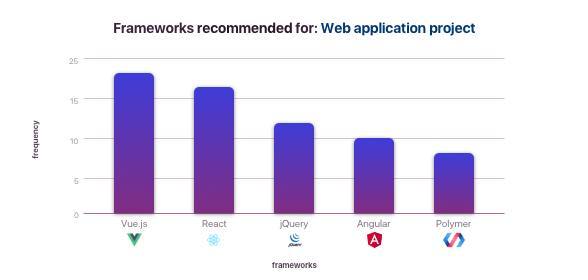
As for the first project, the results were as follows:
1. React
2. Vue.js
3. jQuery
4. Angular
5. Polymer
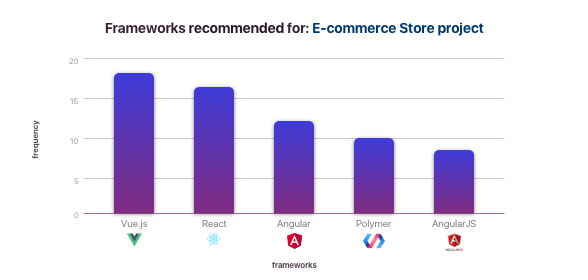
For the second project, an E-commerce store, the results were slightly different. Vue.js outperformed React, taking the first position. Angular and Polymer also got one place higher, with AngularJS closing the list.
1. Vue.js
2. React
3. Angular
4. Polymer
5. AngularJS
Search popularity
We decided to go deeper and compare these front-end frameworks between each other in terms of their search popularity in the world.
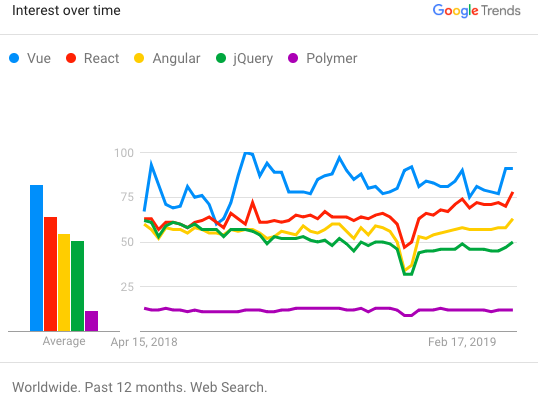
For a comprehensive comparison, we took all 5 front-end frameworks preferred by Edsson developers. Then, we went to Google Trends and analyzed global trends based on certain search queries over the last 12 months. Here’s what we’ve got:
Front-end Frameworks overview:
React
As a Javascript library for UI, React is known for its potential to create irresistible user interfaces. Chosen by such world-renowned companies as Uber, Facebook, Twitter, Airbnb, and PayPal, React is perfect for small, medium, and large-scale projects.
Vue
The main idea behind this framework is to make components of UI easier for comprehension. Compared to other frameworks, Vue.js is less dogmatic and easier for use. Probably, that’s one of the reasons Alibaba, Expedia, and Nintendo go for it.
JQuery
This cross-platform Javascript library became completely irreplaceable in certain contexts.
Its main strengths are quick bug detection and nearly instant processing speed. These strengths make JQuery a preferred choice among LinkedIn, StackOverflow, Twitter, Reddit, and Wikipedia.4.
Angular
Based on TypeScript, this JS framework is considered to be a safe choice for everyone looking for a solution with all components already packed in. Probably that’s the reason Forbes and Wix are built on Angular too.
Polymer
Polymer is a functional library for developing various web components which are then used to develop web pages or web apps. These components may include browser APIs and various HTML elements. Businesses go for Polymer because it reduces the complexity of processes required to build a modern website. As a result, they get lighter libraries and faster apps, which are extremely easy to understand, scale or customize. Polymer is currently chosen by YouTube Web, Google Music, Google Earth, and others.
Interests over time
Now that you know what front-end frameworks are popular and why, we suggest you go one step further and take a look at the chart below.
The numbers represent search interests in relation to the highest point of the chart for the given geographical and time scope.
As you can see, a value of 100 is the peak of the popularity for the search term. A value of 50 means that the term is half as popular compared to the most popular one. A zero score means that the data for this term was not representative enough or was missing.
Front-end frameworks popularity
Over to you
As you can see, there is no perfect front-end framework out there. Every tech stack suits for individual needs of the project. For this reason, your choice of the best-fitting framework should always rely on the specific goals and objectives of your business at this specific time.
We carried out this research to drive your attention to the choices of top front-end frameworks. As you can see, universal frameworks simply do not exist. However, there are certain technology trends that make an impact on the choice of the tech stack. If you take them into account, the ideal framework will find you. Good luck!
Featured content
The Future of AI in Financial Services
Daria Vasylenko
Leveraging Predictive Analytics for Better Business Decisions
Daria Vasylenko
Edsson's AI-Assisted Software Development: A New Paradigm for Accelerating Time-to-Market
Dmytro Plotnikov
Digital Transformation in Retail: Key Trends for 2024
Natalya Repetatska